






Looking to buy a new scooter deck? Or maybe you’re building a custom stunt scooter from scratch?
In both cases, before buying you should consider a few important factors that will help you make the right choice.
Stunt scooter riding style.
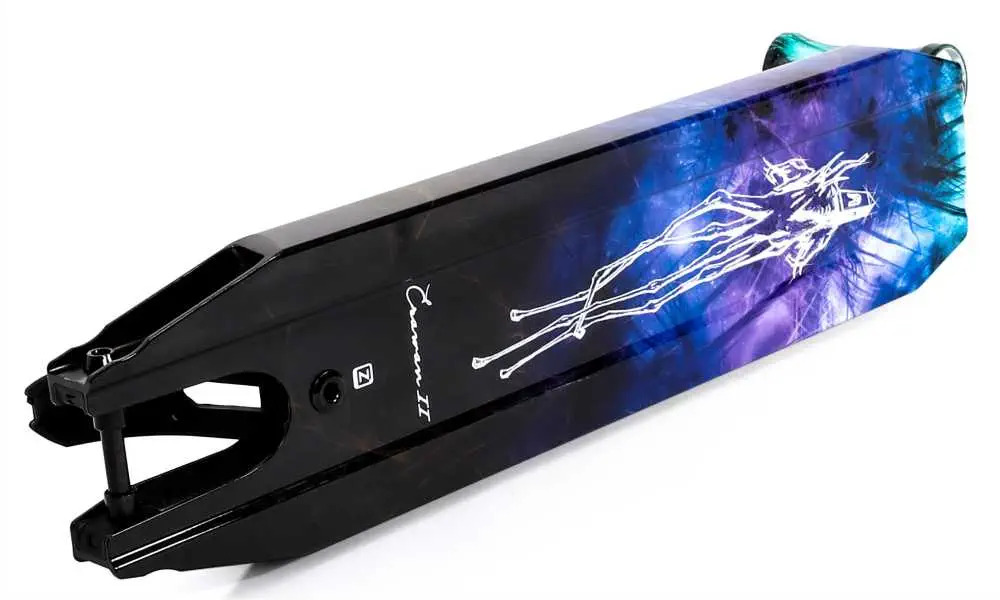
You can choose between Park and Street, and the construction of decks differs significantly – just like the overall build of the scooter.
If you’re putting together a setup for skatepark riding, go for a lightweight, compact deck with cut-out sides. If street tricks are your style, you’ll need a more massive deck – choose a Boxed shape.

Want to know more differences between a street scooter and a park scooter? Read on…
Material of the scooter deck.
The material affects both weight and durability. Expensive decks are usually aluminum, while cheaper ones may use Cro-Mo steel.
Aluminum can be heat-treated for extra strength. An aluminum scooter deck is lighter, but if you’re a beginner without proper skills, it’s easier to damage.
A Cro-Mo steel deck will be heavier but also more affordable. It absorbs vibrations better and works well for beginner riders, as it’s harder to break.
Keep in mind that no deck is indestructible, no matter how well it’s made.
Scooter wheel diameter:
Your chosen deck has cutouts for wheels – check the description to see what wheel diameter fits. Width matters too, especially if you prefer wider-than-standard wheels.
Also make sure the wheels you pick fit your fork.
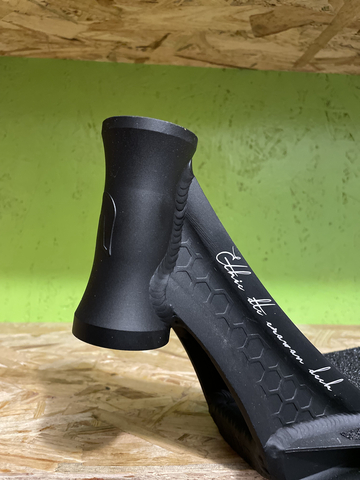
Stunt scooter headtube.
The headtube (also called the head tube) is an important part because other components depend on it.
There are two types: integrated and non-integrated. They differ in construction.
In a non-integrated headtube, the headset cup is a different color and wider than the tube. Integrated headsets blend with the headtube color and look seamless.
Important: Non-integrated headtubes are found in cheap scooters and only fit non-integrated headsets. Assembly can be tricky. High-quality scooters use integrated headtubes – easier to assemble and only for integrated headsets.
The headtube is also called the “tube” or “chimney” and it’s where the fork goes through. Make sure the fork matches the headtube length. A fork that’s too short may not fit your compression system. For integrated headtubes, only threadless forks are suitable.
Scooter headsets.
They must match the headtube type. Integrated headtube = integrated headset, non-integrated headtube = non-integrated headset.
The headtube angle also matters – it determines the handlebar position. Angles on stunt scooters are usually between 80° and 85°, with most around 83°.
Scooter brake.
If the deck comes with a brake, no problem. If not, make sure the deck has the same bolt spacing as your brake.
Scooter deck length.
Deck length is crucial – you need enough space, especially with bigger feet. Longer decks = more stability, shorter decks = better for park tricks and ramps. Typical stunt scooter deck length is 48–56 cm, with park decks usually 48–53 cm.
Scooter deck width.
Width also matters – you need to feel comfortable during tricks. Riders with larger shoe sizes should choose wider decks. Stunt scooter decks range from about 10.5 cm to 12 cm in width.


