





Buying guide for beginner riders – and everyone else.
How to buy and match parts for a stunt scooter?
If you own a stunt scooter, sooner or later you’ll need to replace the wheels.
For seasoned riders that’s easy, but if you’re just starting out, the sheer number of models and designs can be overwhelming. Below are the most common questions customers ask us – with clear answers.
1. How do I choose wheels for a stunt scooter?
Before you go on a shopping spree, check which scooter wheels actually fit your setup.
Scooter wheel sizes
In our store we offer wheels in the following diameters:100 mm, 110 mm, 115 mm and 120 mm
And in widths from 24 mm to 30 mm.
Match the wheels to your deck and fork. If your scooter came with 110 mm wheels, it will usually accept 110 mm and 100 mm. You’ll find the stock wheel size in the scooter’s product description. If you want to go bigger than stock, measure the distance from the axle to the inner side of the fork – like in the photo below.

Below you can see a fork and three wheel sizes. As you can tell, 100 mm (pink) and 110 mm (green) fit, but 120 mm (silver) do not.

Also measure the clearance in the deck to make sure the wheel will fit.

Most wheels are about 24 mm wide, but wider options exist. Always check the wheel specs carefully. Measure your fork spacing as well, so the width and spacers match the wheels you choose.
Choosing the right diameter
This is personal – just like bar height. The more you ride, the clearer your preferences become.
100 mm wheels are great for beginners: they’re lighter, turn quicker and accelerate faster, so they’re easier to control. Larger wheels need more skill and power to get going, but roll faster and smoother – street riders often prefer them.
If you don’t have strong preferences yet, 110 mm is a safe all-round choice: a balance of speed and agility.
Once you pick a size, it’s time to choose the wheel type.
2. What types of stunt scooter wheels are there?
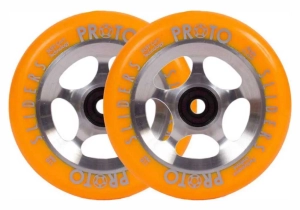
We differentiate wheels by their core (the middle structure of the wheel):
- Solid core – full core; stronger and more impact-resistant, but heavier.
- Spoked core – open spokes like a car rim; lighter, but less durable and more prone to damage.
- Hollow core – closed sides with a hollow interior; very light, usually stronger than spoked, but not as tough as solid.
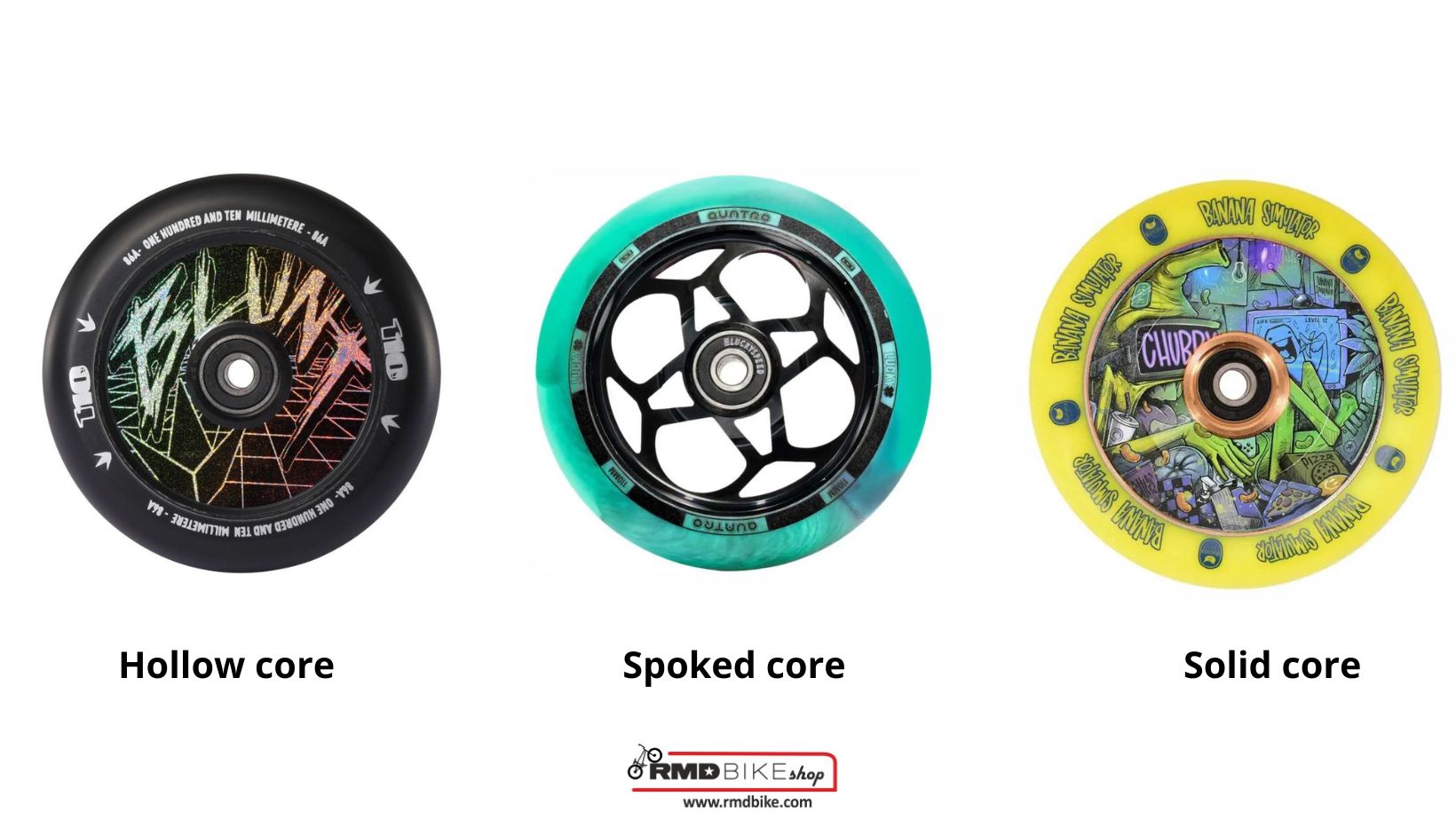
Some brands use signature cores, e.g. Root Honeycore (honeycomb) or CORE Hex.
Decide what matters most: weight, strength – or a smart compromise. Unsure? Try different types and see what you like.
Wheel profiles
Stunt scooter wheels typically come in two profiles:
- Flat – more surface contact and grip.
- Narrow / round – higher top speed and easier carving.
Grip or speed – test both and pick what suits your riding style.

Wheel hardness (durometer)
Wheel hardness is given in durometer (A scale) from 0A to 100A. The higher the number, the harder the wheel. Soft wheels are typically ~82A–88A.
Softer wheels grip better and absorb impacts – great for skateparks and ramps – but they wear faster. Harder wheels roll quicker on street and asphalt, grip less, and resist wear better.
If you’re unsure where to start, pick a versatile 88A and experiment from there.
3. Which stunt scooter wheels should I buy?
Quick checklist:
🛴 Confirm the diameter and width that fit your scooter (fork, deck, brake, spacers).
🛴 Decide what you value more: speed or agility.
🛴 Choose between light weight and maximum durability – or a balance.
🛴 Think where you ride most: park or street, ramps or asphalt.
Answer these and you’ll quickly find the right wheels. Test different sizes, cores and durometers until you land on what feels best. What works for your friend won’t always be ideal for you.


