


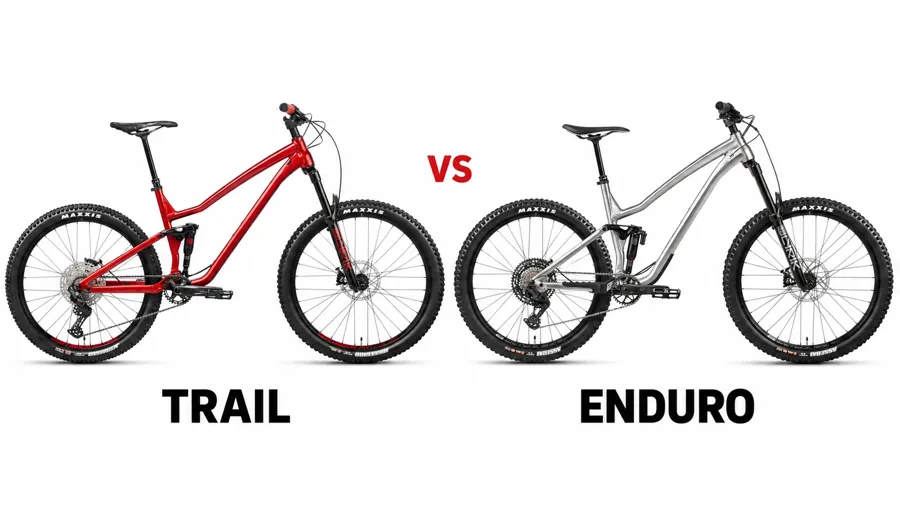
You like riding through the woods, finding new trails and tackling rooty descents. Now you are thinking about a trip to the mountains or a bike park. Will a trail bike do the job, or should you go straight for an enduro bike?
Both can be great fun. The choice becomes clearer when you look at your own riding: how much you climb, the descents you choose and where you spend most of the season. Start there.
A trail bike for varied riding
A climb, a quieter stretch of trail, a few turns and a descent that makes you work a little harder. If that sounds like your favourite loop, a trail bike could be a good fit.
It is a broad category. Some models focus on longer rides and efficient pedalling; others are well suited to more demanding descents. The word ‘trail’ does not tell you everything.
Look at how the particular bike is built and what the manufacturer intends it for. If you want a bike for woodland paths, mountain rides and exploring new places, trail bikes are a useful starting point.
When does an enduro bike make sense?
If you spend the climb thinking about the descent, take a closer look at enduro bikes.
They put more emphasis on demanding descents: steep sections, rocks, roots and repeated rough ground. They usually have more suspension travel and geometry designed for stability on that terrain. You can still pedal back to the top.
Consider an enduro bike if you regularly ride in the mountains, choose challenging trails or spend a lot of time at bike parks. That is where you are more likely to use its capabilities.
You can ride it on a gentle woodland loop too. The question is whether you need a bike focused on harder descents. Check the intended use and manufacturer's limits for each model, especially if you plan to jump or ride in bike parks.
What about climbing? Will an enduro bike be too heavy?
Enduro bikes can climb; that is part of their purpose. Some are more enjoyable than others when you are pedalling for hours.
Weight makes a difference, but so do the tyres, gearing, riding position and suspension setup. Tyres chosen for grip on demanding descents can create more rolling resistance on easier sections. What helps on one part of the ride may take more effort on another.
If you enjoy long rides with plenty of climbing, compare enduro and trail bikes. Do not base the whole decision on the hardest descent you ride a few times a year.
More travel is not always better for your riding
It is easy to read a specification and assume that more suspension travel means a better bike. You are choosing for your riding, though, rather than trying to win a comparison of numbers.
More travel can help on demanding descents. It cannot replace suitable geometry, good tyres or a correctly set-up fork and rear shock.
There is no fixed boundary between trail and enduro. Models from different manufacturers overlap. Look at the whole bike and its intended use instead of judging it by fork travel alone.
What should you check when choosing a bike?
A size that gives you room to move
Start with the manufacturer's size chart, then compare geometry, especially if you are between sizes.
Reach is one useful measurement: it helps you compare the space available when you are standing on the pedals. Front-end height and your seated pedalling position matter too. Two bikes labelled medium can feel quite different.
Do not buy a larger frame just because you expect it to feel more stable downhill. You also need room to move and a bike you can control comfortably.
Brakes and tyres that suit your trails
On a long descent, you want to control your speed from top to bottom. Check the actual brake model and rotor sizes. ‘Hydraulic’ on its own tells you too little.
For tyres, look at the tread, rubber compound and construction. Gentler dry trails may call for a different setup from rocky descents. Your choice affects both grip and the effort needed to pedal.
A budget that covers preparation and servicing
Leave some of your budget for a well-fitting helmet, the protective pads you need and getting the bike ready to ride. Check whether pedals are included too.
Before the first ride, the bike must have an initial inspection at a professional bike workshop. Choose a workshop with experience of trail and enduro bikes: not every workshop can correctly set up the fork and rear shock and prepare the brakes on this type of bike. When booking, ask for the suspension to be set up for your weight and the brakes to be checked. This is a paid service. Keep the confirmation and read the manual and warranty terms.
Regular servicing comes after that. On a full-suspension bike, the fork, rear shock and frame suspension components need attention too.
So, which should you choose?
For woodland rides and mountain routes with climbs, consider a trail bike.
If demanding descents and bike park riding come first, consider an enduro bike.
Choose for where you actually ride. One planned bike park visit need not decide your bike for the entire season. On the other hand, if you spend almost every weekend on demanding mountain trails, take that into account from the start.
Compare our trail and all-mountain bikes and browse the wider mountain bike range. Torn between models? Tell us where you ride, your height and your budget. That gives us much more to work with than simply asking which bike is best.
Enduro or trail: common questions
Will an enduro bike be too much for my local trails?
If your rides are mostly gentle paths, short descents and plenty of pedalling, you may rarely use its capabilities. Compare it with a trail bike. Enduro makes more sense when you regularly choose demanding descents, rather than only hoping to ride them one day.
Can you take an enduro bike on long rides with climbs?
Yes, but much depends on the particular bike, its setup and your fitness. Compare the gearing, tyres, weight and pedalling position. If long rides make up most of your riding, look at trail bikes too.
What if my enduro bike descends well but feels hard to pedal uphill?
Before replacing parts, check your riding position, suspension setup and tyre pressures against the manufacturers’ guidance. Look at the tyres themselves too: a set chosen for demanding descents can noticeably increase rolling resistance. Match any changes to your trails so that you keep the grip and tyre protection you need on the way down.


