


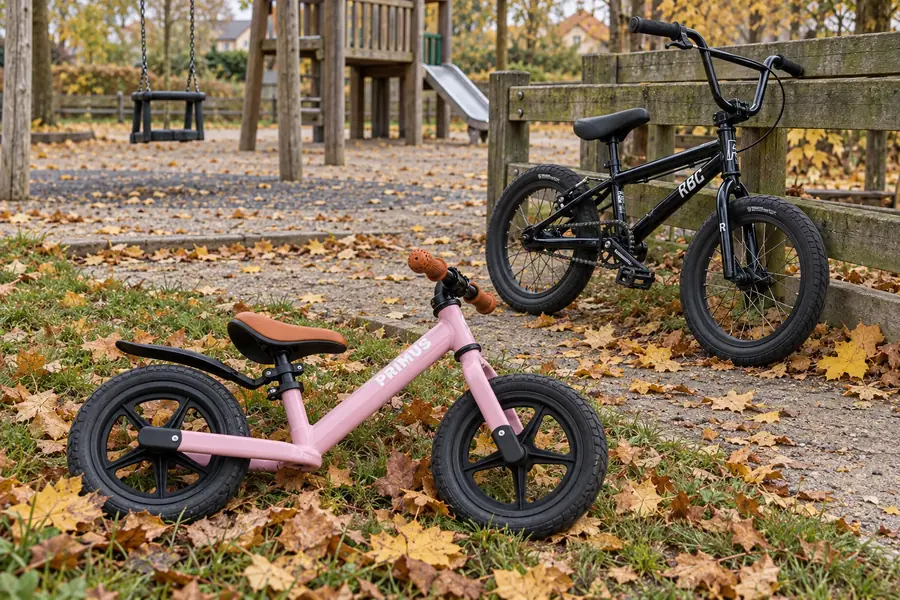
Image generated using AI.
Buying your child’s first bike and wondering whether to start with a balance bike or pedals? Perhaps their friends are already pedalling, while your child is only just showing an interest. Or you’re worried they’ll outgrow a balance bike too quickly. Here’s how to choose a bike they can manage now.
Start with a balance bike or go straight to pedals?
If your child hasn’t ridden on two wheels before, a balance bike lets them get started without having to pedal. They push along with their feet, learn to steer and gradually try lifting their feet off the ground to balance. Once they can glide, turn and stop, you can offer them a go on a pedal bike.
What if they’ve never had a balance bike? They can learn on a pedal bike, but they’ll be learning to balance and pedal at the same time. Choosing the right size and giving them time matters more than assuming they’re ready because they’ve reached a certain age.
Which bike should you choose for a two-, three- or four-year-old?
Children of the same age differ in more than height. Some are keen to try new things; others need longer to feel comfortable. Balance and coordination develop at different rates too. One child may soon be gliding with both feet up, while another spends longer taking small steps.
Watch how your child moves and whether they want to try riding. Age alone won’t tell you if they’re ready for pedals. Being brave doesn’t replace the ability to steer and stop, either.
Treat the age range in a bike’s description as a starting point. Then check the recommended rider height and the dimensions of that particular model. Your child should be able to reach the handlebars, support themselves with their feet and get off the saddle without help.
There’s no need to rush the move to pedals because other children are already pedalling. A balance bike can still be fun on walks together, even after your child has started trying a pedal bike.
Balance bike, tricycle or stabilisers?
A child who has ridden a tricycle may already understand pedalling. That doesn’t mean they can balance on two wheels: the third wheel was providing support.
Stabilisers provide support in a similar way, allowing a child to concentrate on pedalling. Once they come off, the child still needs to learn to balance independently. On a balance bike, they practise that skill from the start, gradually travelling further without touching the ground.
Stabilisers aren’t a compulsory step. If your child can balance, steer and stop on a balance bike, you can try a correctly sized pedal bike without fitting stabilisers.
A first bike with 12-, 14- or 16-inch wheels?
Wheel size alone won’t tell you whether a bike fits. Two bikes with 14-inch wheels can have different saddle heights, frame lengths and distances to the handlebars. One may fit your child while the other is too big.
When buying online, start by measuring your child’s height and inside leg. Compare those measurements with the manufacturer’s guidance for the model you’re considering, and check its minimum saddle height. If the description doesn’t include that information, ask us before ordering.
On a balance bike, you should be able to set the saddle so your child can place both feet flat on the ground with their knees slightly bent. This lets them push along and support themselves. Being able to put their feet down easily also matters on a first pedal bike, while they learn to start and stop.
Once the bike has arrived and been correctly assembled, check that your child can reach the handlebars, operate the brakes and get off the saddle without help.
How to measure your child’s inside leg
You’ll need a book. Ask your child to stand against a wall, then place the book between their legs with its spine facing upwards, at crotch height. Measure from the floor to the top edge of the book.
Check whether the manufacturer asks for this measurement with shoes on or off, and follow its instructions. That way, you’re comparing like with like.
Don’t apply one brand’s sizing advice to every other brand. The same wheel size doesn’t mean the whole bike has the same dimensions.
Should you buy a bigger bike so it lasts longer?
If your child has to stretch to reach the bars or struggles to get off the saddle, that model will make learning harder. Try a smaller size or a bike with different geometry.
Look for a bike that fits now and allows some adjustment as your child grows. Compare weights too. Your child will need to push the bike, turn it around and pick it up after a tumble, as well as ride it.
If you’re choosing a balance bike, compare the dimensions and rider-height guidance in our balance bike range.
For small BMX-style bikes, browse our 12-inch, 14-inch and 16-inch BMX categories. Check whether the model has pedals, along with its recommended rider height and dimensions. Wheel size alone doesn’t determine the fit.
Not sure which models to compare? Get in touch with your child’s height, inside-leg measurement and a little about how they’re getting on with a balance bike. We’ll help you narrow down the choice.


